
Lens performance
The lenses of medium format vintage folding cameras are either triplets (three lens elements) or Tessar types (four lens elements in three groups, with two lenses cemented). These lenses show their best performance (contrast and sharpness) when stopped down. At their full aperture (commonly f/3.5 or f/4.5) these lenses are quite soft with a dreamy or pictorial look. Some photographers prefer the soft look of the Novar, for example in portrait photography.
The optimal aperture of the Zeiss Ikon Novar Anastigmat is in the range of f/8 to f/16-22. Compared to the prestigious Tessar, the Novar is softer at wider apertures. Closing the aperture continuously widens the diameter of the sharp central area, but the sharpness of the center does not reach the extreme corners. The sides and corners sharpen up nicely and vignetting is reduced significantly at smaller apertures. However, the extreme corners are still rather soft, even when stopped down to f/22. Stopping down to f/32 normally decreases sharpness as a result of diffraction, a basic phenomenon of the physics of light.

Beech forest in spring (Zeiss Ikon Super Ikonta III (531/16) Novar, Ilford PanF Plus 50, 1/300 sec and f/3.5) – a dreamy or pictorial look at full aperture. For further inspection by zooming in see: https://www.flickr.com/photos/165607631@N07/49942600442/in/photolist-2m1jiqc-2mN7bts-2j6fT8Y-2jfRWGb-2jmRt51-2isU4qD-2jWkytZ-2j6bHaa-2j6fSY9-2isVcAA-2hG1WGu-2hB1Hic-2htJSCw-2j6bGWz-2htJSHg-2fK6rnm-2gK6xiF-2jWgUME-2jbJjQ5/
In contrast to the triplets, the Tessar lenses achieve their higher performance already at wider apertures, with their sweat range beginning at about f/5.6. At full aperture the central area is already rather sharp. At smaller apertures, there is no distinct advantage of the Carl Zeiss Tessar over the Zeiss Ikon Novar. Ivor Matanle, a renowned expert for classic cameras, states in an article on Ikontas: “Other things being equal, the difference between the performance of a correctly set up, clean, unscratched Novar and a Tessar in similar condition will be hard to see in ordinary photography at f/5.6 or smaller” (Rollmodels, published in: Amateur Photographer, 25 October 2003, page 35-40). This corresponds absolutely to my own experience.
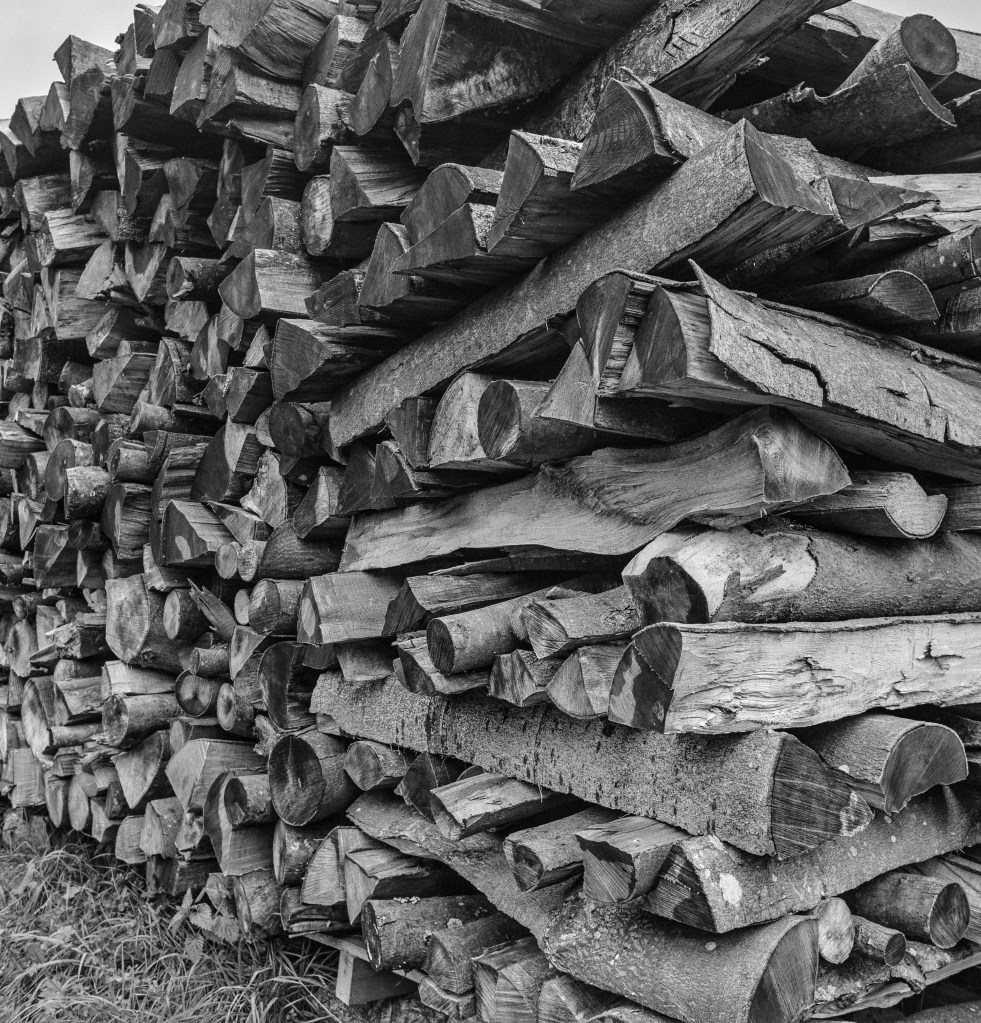
Stack of firewood (Zeiss Ikon Super Ikonta III (531/16) CZ Tessar, Ilford HP5 Plus 400, 1/200 sec and f/16) – the Tessar delivers fine detail and excellent sharpness.
Experts sometimes mention that there is only one specific downside of folder Tessars compared to a modern Tessar lens design: At close distances the front focusing of the folder Tessars, where only the front element moves in and out, is not as good as the “unit focusing” of today’s Tessars.
The Novars and Tessars are relative simple optical constructions without the correction we take for granted in modern lens design. However, in view of the compromise made for cost and portability, the performance of many folding camera lenses is nonetheless respectable.
In addition to the lens performance, some other issues can affect the sharpness of pictures taken with vintage medium format folding cameras:
- hand-held vs tripod
- film flatness
- lens hood
- release mechanism
- extra spring
- camera weight
Hand held vs tripod
In the first volume (The Camera) of his book series on b&w photography, Ansel Adams stated that hand-held shooting with shutter speeds longer than 1/250 sec (based on a lens with normal focal length) result in more or less unsharp pictures as a result of camera shake. The old rule of thumb of the shutter speed being the reciprocal of the focal length to avoid blurred pictures needs to be modified. In particular, 6×9 folding cameras are difficult to hold steady for hand-held shooting.
Also, the shutter release button needs some travel before triggering the shutter and moving the linkage from the body to the actual shutter at the camera front requires some force to operate. The moving parts of the linkage mechanism might be a problem for both hand-held and tripod shooting. For hand-held shots, the linkage can be omitted by using the lever directly at the lens-shutter unit of the camera front standard.
Operating the shutter release button by smooth downward pressure helps to avoid camera shake but possibly results in another problem: the activation of the double exposure prevention mechanism before firing the shutter. In this case the shutter can be fired by using the lever at the the lens-shutter unit.
When adjusting short enough shutter speeds to prevent camera shake, one should consider that old shutters tend to run slow, even after a professional CLA. Adjusting for example a speed of 1/200 sec can absolutely result in an actual shutter speed of 1/100-150 sec (see: Shutter Speed). But using faster shutter speeds will not ensure that all pictures are sharp – some of the shots will still be blurred. Using a tripod definitely helps a lot!
Unfortunately, using a tripod is also no guarantee for pin-sharp pictures. Especially, the shutter release mechanism is prone to cause vibrations, even when using a cable release. The force needed to operate the whole mechanics can move the camera, particularly if mounted on a light tripod. Also, a soft forest ground or a stronger wind can complicate a steady stand.
Film flatness
The commonly suggested actions to ensure film flatness are somewhat contradicting: Some users of vintage folding cameras strongly recommend to wind on the film to the next frame immediately after shooting to prevent inadvertently double exposure. This is a reasonable procedure for cameras without a double exposure prevention mechanism – but at the risk of insufficient film flatness as a result of abruptly unfolding the camera. Others recommend to wind on the film not before erecting the lens standard and only immediately before shooting to ensure film flatness. But sometimes, for one or another reason shots are not executed and the camera has to be folded up for storage in the bag or pocket and has to be unfolded again later on.
My personal solution: After shooting I wind on the film just before the next frame number appears in the middle of the red window at the camera back or (in the case of an automatic film winding mechanism) just before the next frame number moves opposite to the marking at the frame counter. The paper backing usually facilitates winding the film by including warning marks before the actual film numbers appear (e.g., dots, circles or product names). Immediately before shooting I center the frame number in the red window or wind on before the automatic winding stops. If the exposure of the frame has to be delayed for whatever reason, retightening the film by using the winding knob without actually advancing the film can be sufficient to achieve film flatness.

Film flatness issue (Agfa Isolette III Solinar, Kodak Ektar 100, 1/150 sec and f/5.6) – caused by popping out the front standard.
Lens hood
Camera and lens manufacturers and experienced photographers usually recommend to use a lens hood to shade the front lens whenever possible. They all state that there is hardly any photo that does not benefit from using a lens hood and showing increased brilliance and contrast. This is particularly reasonable when using fast lenses with large front lens elements, which are insufficiently shaded by deep lens bezels. Particularly, uncoated pre-war lenses or single-coated post-war lenses are prone to loosing contrast and provoking lens flare, if the sun is shining directly on the front lens.
Unfortunately, original lens hoods of vintage cameras tend to be rare and are rather expensive, if available for example via ebay. Also, they often shadow significant parts of the composition visualized in the viewfinder. Moreover, they have to be removed from the lens each time before folding up and storing the camera in an extra bag or in the pocket. This makes the use of lens hoods cumbersome, especially when shooting the camera hand-held.
My personal handling: I use lens hoods primarily when shooting with the camera mounted on a tripod. I tend to use them on hand-held cameras mostly on sunny days, when light is falling directly on the front lens.
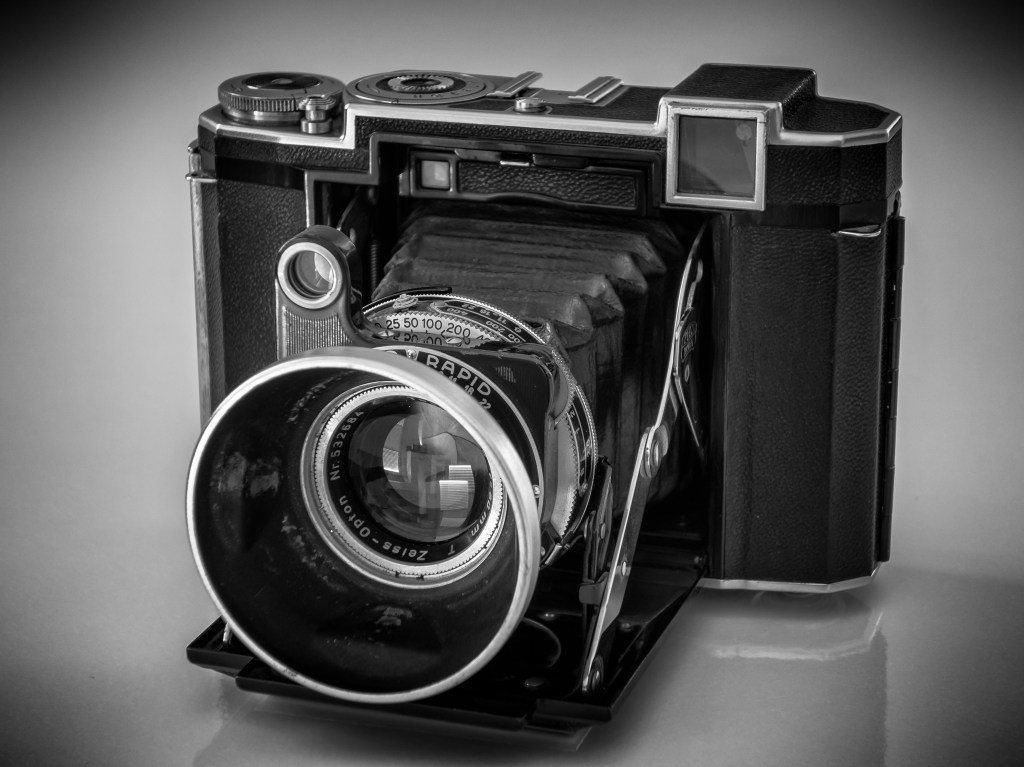
Zeiss Ikon Super Ikonta I/B (532/16) with push-on lens hood.
Release mechanism
Both the position and the free movement of the shutter release button of vintage folding cameras are affecting the sharpness of hand-held shots. Some folders like the older Zeiss Ikon Ikontas and Super Ikontas have placed the shutter release button on the left side of the camera top, which is somewhat awkward and inconvenient for right-handers. The Voigtläner Bessa RF and Bessa II offer a lever formed as catch or hook, extending from the front door when unfolding the camera. Similar to the Zeiss Ikon cameras, the shutter is fired using the left hand, provoking camera shake. Also, the many moving parts of the shutter release mechanism can cause some vibration during exposure. Particularly, 6×9 folders seem to be prone to camera shake, because they are lengthy and have larger and longer linkage parts for transferring the release pressure to the shutter at the front standard of the camera.
Extra spring
The range of shutter speeds of some Compur shutters (particularly Compur Rapid and Sychro Compur shutters) has been extended, providing shorter exposure times (e.g., 1/400 or 1/500 second). To achieve these speeds, a stronger spring with extra tension had been added, which is clearly noticeable when adjusting these exposure times and cocking the shutter. Possibly, this can create extra camera shake that negates the speed advantage when taking hand-held shots.
Camera weight
Relative to their format and focal length vintage medium format folding cameras are rather light. Therefore, some photographers argue that their comparatively low weight in connection with the normally quiet and vibration-free leaf shutter are predestinated for hand-held shooting. However, this means underestimating the advantage of mass inertia of the heavier cameras, which precludes rapid movement.
 Old Glass