
Zeiss Opton Tessar 105 mm
My Ikonta C (6×9 cm format) works flawlessly and therefore has not been CLA’d by a professional camera service until now. I wanted to test the uncoated Zeiss Opton Tessar lens at shorter distances in a real world setting and searched for a suitable photographic subject: a frame filling flat structure in a distance of some meters. Staggered subjects are problematic, since a narrow depth of field at open apertures allows no judgement of sharpness all over the frame. The short distance is typical for getting a pleasing softness in the background, which I like very much. But this is also a demanding distance: Experts state that the front element focusing of the Ikonta and Super Ikonta lenses affect the sharpness of closer subjects significantly more than of distant subjects.
The Opton Tessar of my camera is somewhat odd: The slightly bluish shining front lens element indicates single coating but seems to be a case of surface oxidation, resulting in natural lens coating. Reportedly, there was a short run of uncoated lenses produced in the newly established West-German Zeiss factory immediately after the war. Zeiss-Opton Tessars produced later were always coated and for indication a red “T” has been engraved into the front cell bezel. According to its serial number, the lens of this camera was produced between 1946 and 1951, presumably already in 1946 (see low range number): http://camera-wiki.org/wiki/Carl_Zeiss_serial_numbers
I photographed a book shelf in my living room at a distance of 3 m, using a sturdy tripod without extending the center pillar and the legs and a cable release to avoid camera shake. I opted for Ilford FP4 Plus film for its fine grain and performed the test utilizing the diffuse and uniform light of an overcast day. I wanted to avoid fooling by good subject contrast rather than true sharpness. The scans were not post-processed (no sharpening, only slight adjustments of the brightness of some shots to compensate for inaccurate shutter speeds). The crop series (400 x 600 pixels each) are from the center and the corner bottom left of the full frame (3700 x 5400 pixels).
Camera: Zeiss Ikon Ikonta C (521/2) 6×9 cm
Lens: Zeiss Opton Tessar f/3.5 105 mm
Film: Ilford FP4 Plus 125, exposed at ASA 100
Exposure: 1/2 – 30 sec, tripod and cable release
Subject: book shelf, distance: 3.0 m
Result
Sharpness (contrast, resolution) in the center:
f/3.5: very decent, slightly soft from lack of contrast
f/5.6 to f/22: very sharp with no noticeable increase of sharpness
f/32: no noticeable decease of sharpness through diffraction
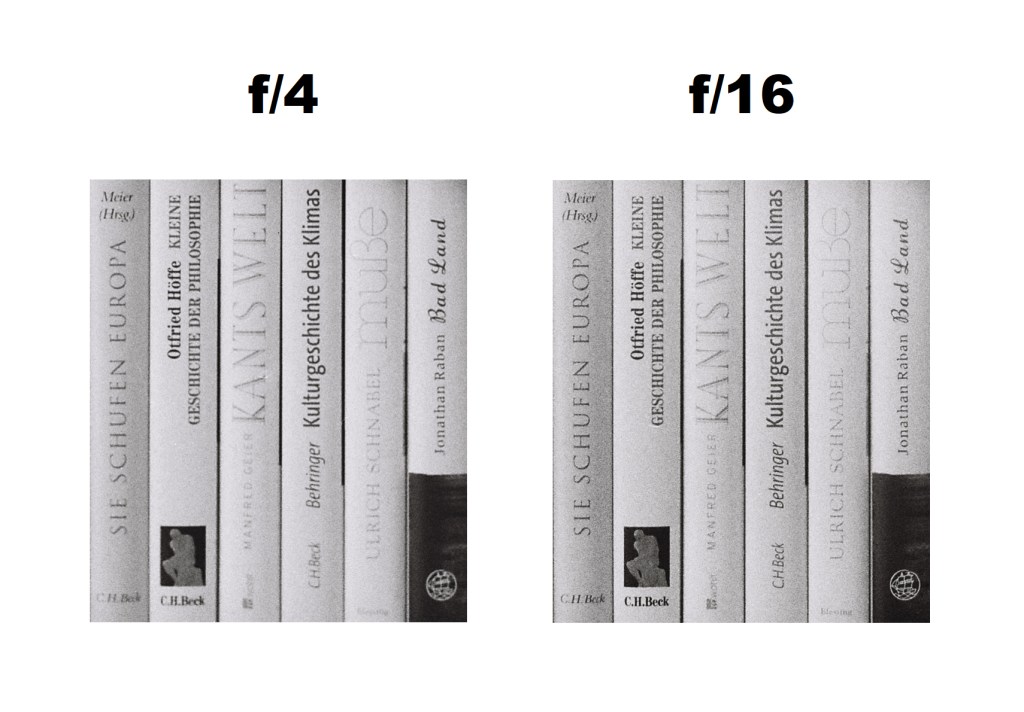
Center sharpness at f/4 and at f/16
Sharpness (contrast, resolution) in the corner:
f/3.5: blurred and soft from lack of contrast
f/5.6: no significant improvement of sharpness
f/8: a moderate increase of sharpness
f/11: a significant improvement of sharpness
f/16: another noticeable increase of sharpness
f/22: about the same sharpness as at f/16
f/32: no noticeable decease of sharpness through diffraction

Corner sharpness at f/4 and at f/16
Verdict
Carefully inspecting reveals: At apertures wide open, the Tessar delivers already decent sharpness in the center, but the sides and corners are blurred and soft through low contrast and low resolution. Closing the aperture widens the diameter of the sharp central area. The sides and corners sharpen up nicely and vignetting is reduced significantly. From f/5.6 to f/32 the central area is very sharp with no noticeable increase of sharpness. The corner sharpness improves significantly not until f/11. At f/16 the sharp area of the center reaches the corners, which appear as sharp as the central area. At f/32 there is no noticeable decease of sharpness through diffraction. All in all, the results of this lens test are in accordance with various tests found in the internet. Obviously, the performance of my Tessar is typical for Tessar-type lenses.
The softness of the extreme corners even at smaller apertures is not a drawback in my opinion. Depending on the specific composition, it can draw the viewer’s eye straight to the main subject in the center. The characteristics of the optical performance of this 105 mm Tessar is quite similar to the 75 mm Tessar of my 6×6 cm Super Ikonta III – with one specific difference: The panoramic 6×9 format implies that the sharpness of the central circle reaches the long sides before the short sides improve. The decent sharpness of the central area already at apertures wide open is definitely a major advantage over the triplet-type Novars, particularly in low light situations.
This is no scientific test, since I exposed only one single frame for each aperture – shutter speed combination. Also, the results are only meaningful for the specific lens of my camera. Due to the comparatively large spread of standard factory models in the fifties, other lenses of the same type possibly show somewhat different results. However, I’ve got some feeling for the effect of opening and closing the aperture regarding the optical performance of my lens.
 Old Glass
You must be logged in to post a comment.