
Zeiss Ikon Novar Anastigmat 75 mm
There have been a lot of discussions in photographic forums about the optical performance of Novars or other triplet lenses, particularly in comparison to the higher graded Tessar or its clones. However, for one or the other reason many lens tests seem to be not very meaningful. More often than not the cameras and lenses have not been CLA’d and possibly suffer from one of the many usual flaws of vintage cameras: light leaks in the bellows, haze in the lens, misaligned focusing, lack of film flatness, no rigid lens standard etc. Also, lens testing is sometimes performed using expired films. But for example, the low contrast of a specific lens design can hardly be distinguished from haze on lens elements.
My Super Ikonta III has been CLA’d by a professional camera service. I wanted to test the Novar triplet lens at shorter distances in a real world setting and searched for a suitable photographic subject: a frame filling flat structure in a distance of some meters. Staggered subjects are problematic, since a narrow depth of field at open apertures allows no judgement of sharpness all over the frame. The short distance is typical for getting a pleasing softness in the background, which I like very much. But this is also a demanding distance: Experts state that the front element focusing of the Ikonta and Super Ikonta lenses affect the sharpness of closer subjects significantly more than of distant subjects.
I photographed a book shelf in my living room at a distance of 3 m, using a sturdy tripod without extending the center pillar and the legs. To avoid any camera shake, I used the self-timer rather than a cable release. I opted for Ilford FP4 Plus film for its fine grain and performed the test utilizing the diffuse and uniform light of an overcast day. I wanted to avoid fooling by good subject contrast rather than true sharpness. The scans were not post-processed (no sharpening, only slight adjustments of the brightness of some shots to compensate for inaccurate shutter speeds). The crop series (500 x 500 pixels each) are from the center and the corner bottom left (not from the extreme corner) of the full frame (5000 x 5000 pixels).
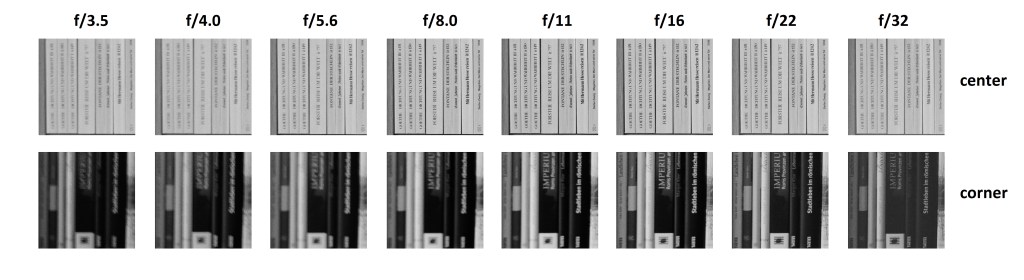
For further inspection by zooming in see: https://www.flickr.com/photos/165607631@N07/51717592624/in/photolist-2mN7bts-2jxv1eJ-2jmRt51-2isU4qD-2jxzoRD-2isVcAA-2hB1Hic-2jxuZaQ-2jxyhrF-2fK6rnm
Camera: Zeiss Ikon Super Ikonta III (531/16)
Lens: Novar Anastigmat f/3.5 75 mm
Film: Ilford FP4 Plus 125, exposed at ASA 100
Exposure: 1/50 – 1 sec, tripod and self-timer
Subject: book shelf, distance: 3.0 m
Result
Sharpness (contrast, resolution) in the center:
f/3.5: blurred and soft from lack of contrast
f/4.0: about the same, no visible improvement
f/5.6: a moderate improvement of sharpness
f/8.0: a significant improvement of sharpness
f/11: another moderate increase of sharpness
f/16: about the same sharpness as at f/11
f/22: a slightly decreasing sharpness
f/32: a further decrease of sharpness
Sharpness (contrast, resolution) in the corner:
f/3.5 to f/8: strong blurring with only minor increase of sharpness
f/11 to f/22: sharpness improves continuously and is best at f/22, but still not as sharp as in the center area
f/32: decrease of sharpness
Presumably, the reduced sharpness in the center and in the corner of the frame at the smallest aperture f/32 results from lower contrast caused by diffraction.
Carefully inspecting the full frames reveals: Closing the aperture continuously widens the diameter of the sharp area, but the sharp area of the center does not reach the extreme corners. The sides and corners sharpen up nicely and vignetting is reduced significantly at smaller apertures. However, the extreme corners are still soft when stopped down to f/22. All in all, the results of this lens test are in accordance with various tests found in the internet. Obviously, the performance of my Novar is typical for triplets.
Verdict: At apertures wide open, the Novar delivers a dreamy look suitable for creating pictorial photographs. The sharpness improves significantly at f/8. Stopped down to f/11 or f/16 the pictures are pin sharp and can hardly be distinguished from those of the more prestigious Tessar. The softness of the extreme corners even at smaller apertures is not a drawback in any case. Depending on the specific composition, it can draw the viewer’s eye straight to the main subject in the center. Compared to the Novar, the Tessar of my other Super Ikonta III is sharp already at wider apertures – at least in a large area in the center. This is definitely a major advantage, particularly in low light situations. Also, the contrast in sharpness of a sharp foreground versus a blurred background is more distinct.
This is no scientific test, since I exposed only one single frame for each aperture – shutter speed combination. Also, the results are only meaningful for the specific lens of my camera. Due to the comparatively large spread of standard factory models in the fifties, other lenses of the same type possibly show somewhat different results. However, I’ve got some feeling for the effect of opening and closing the aperture and learned that sharpness at f/8 is acceptable and f/11 – f/22 is the sweet aperture range of my Novar.
See also my flickr photo gallery: https://www.flickr.com/photos/165607631@N07/
 Old Glass