
After receiving a vintage folding camera, the first and most important problem is, how to get it working properly. When the camara has been restored successfully, the question arises, which kind of film is most suitable for a vintage camera. Black & white film for its pictorial timeless look? Color negative film (rather than slide) film for its higher dynamical range? And if one opts for black & white film: Are the classic cubic grain based films like Kodak Tri-X or Ilford HP5 a better choice than modern T-grain based films like the Kodak TMax or Ilford Delta films series? In the first instance, all depends on personal preferences and taste. But technical reasons (e.g., sesitivity or pushing behavior) may also be relevant.
One may decide that a film that preserves the character of a vintage lens is a better camera film combo. Or one may decide to compensate for lower contrast of old lenses using a more contrasty film, typically a film with lower sensitivity. Finally, one may decide to use no color film at all, because often it has been stated that old lenses (particularly uncoated pre-war lenses) render colors unsatisfactory. Subsequently, some thoughts based on my own experience:
Black & white film
The performance of old lenses was limited by the amount of aberrations corrected through their optical construction and the kind (or lack) of lens coating leading to a distinct softness. Particularly, uncoated pre-war lenses show a different rendering compared to multi-coated newer optical constructions. The pictures are not as crisp as those taken with modern lenses.
Old lenses are more transparent regarding blue light. As a consequence, the shadows with their large amount of bluish straylight are lifted and appear lighter, showing more detail. The overall contrast is lower and more balanced. Therefore, they are more tolerant with regard to high contrast scenes. There are less blocked shadows and less whitewash, for example when shooting in a dark forest on sunny days.

Protected forest (Zeiss Ikon Super Ikonta III, CZ Tessar, Ilford HP5 @ ISO 400, 1/200 sec and f/8)
The pictures taken with uncoated lenses normally show some kind of an aura around the contours. The highlights tend to creep into the shadows generating a beautiful glowing, in German sometimes called “Schmelz”. Not surprisingly, uncoated lenses are more prone to lens flares in direct light or back light, particularly when used without lens hood.
Once I’ve changed from analog to digital photography for its perfection, and later changed back to film photography for its imperfection. I quite like the softness of vintage lenses and normally do not compensate for their lower contrast using more contrasty films. Meanwhile, I’m somewhat jaded by the mass of clinical sharp and overly brilliant high contrast pictures seen in the web. If increased contrast is needed, I modify the contrast in post processing via Adobe Lightroom or Nik Silver Efex. Under my workflow increasing low contrast is much easier than lowering high contrast. Pushing development is another possibility to increase contrast.

Beech trees in spring (Zeiss Ikon Super Ikonta III, Novar, Ilford HP5 @ ISO 800, 1/200 sec and f/8)
As for the film characteristics: The films used decades ago were generally slower and grainier than the films we use today. Also, they had much lower sensitivity to red light than modern films. To realize a distinct grain, classic films like Kodak Tri-X or Ilford HP5 with cubic grains are better suited than modern film emulsions with T-grains.
Recently, I used Fomapan 400, which has a quite different look and seems to be an alternative for specific intensions and photographic subjects. This classic film emulsion delivers more distinct grain (e.g., compared to HP5), more sooty dark tones and some blooming of the highlights, which can emphasize the mood of a picture very favorably. However, the sensitivity of this film emulsion seems to be lower than box speed, because the shadows tend to lose detail. Normally, I expose Fomapan 400 at ISO 200.
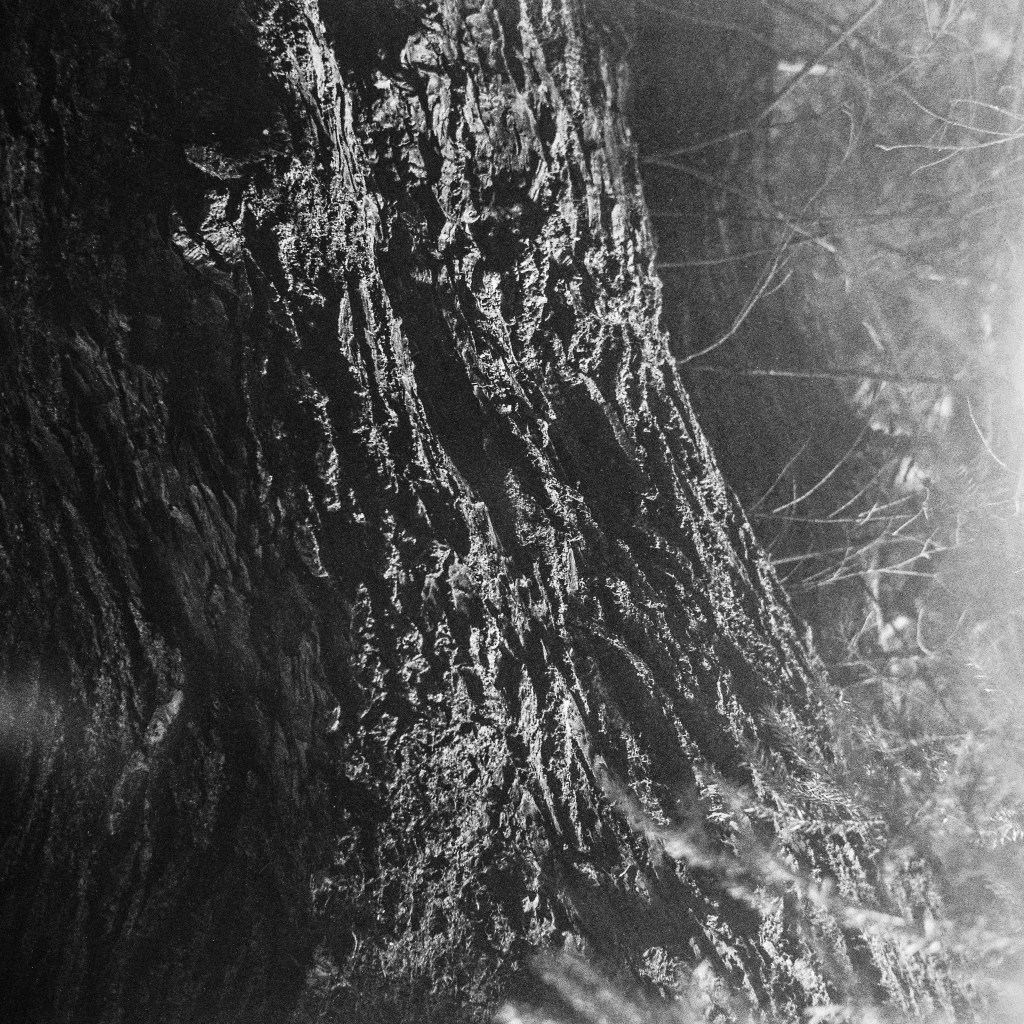
Tree detail (Zeiss Ikon Super Ikonta III, CZ Tessar, Fomapan 400 @ ISO 200, 1/200 sec and f/8)
In comparison with Ilford HP5 Plus and Kodak Tri-X, the first scans of Fomapan Action 400 came from the film lab with higher contrast and a more distinct grain. Regarding its contrast, this contradicts with many statements that the film has a comparatively low contrast, with overexposure being even lower. Nevertheless, this film definitely has a unique look, which is appreciated by many photographers. This film and a vintage folding camera seem to be a good combo and I decide to investigate this furthermore.
Fomapan Action 400 has much more sensitivity to the red end of the spectrum than it has in the blue and green region, so to speak a built-in orange or red filter. As a result, blue skies, green leaves and the shadow areas in general come darker in tonality. The darkening of the foliage and the shadows seems to pretend the higher contrast. The softening effect by overexposure is said to result from a poor anti-halation layer. The light bouncing around causes halos and glowing highlights, creeping into the darker areas and tending to wash the highlights out.
The more distinct grain results from the cubic grain structure of the emulsion. In contrast to the softer grain pattern of the tabular grain of modern films like the Ilford Delta or the Kodak TMax film series, cubic grain is more apparent. Together with its deep black and the glowing highlights, Fomapan Action 400 can produce the beautiful and timeless look of classic film emulsions, different from other b&w films and quite different from digital rendering.
The overall contrast and the graininess can both be reduced by overexposure. Rating Fomapan 400 @ ISO 200 seems to be a good idea to open up the shadows for showing more shadow detail.
For more information see the very interesting film reviews of Blue Moon Camera & Machine: https://bluemooncameracodex.com/film-fridays/fffomapan400
I appreciate very much the softness and grain structure as well as the pushing possibilities of Ilford HP5 Plus. Therefore, this b & w film has become by far my favored film stock for hand-held shooting. Sometimes, I use Ilford PanF 50 (another classic cubic grain film) for tripod based shooting of low contrast scenes and enjoy its fine grain and high resolution to emphasize details.
Folding cameras are compact and light relative to their format and focal length. As a result, they are prone to camera shake (6×9 folders even more than 6×6 folders). For hand-held shooting, exposure times longer than 1/200 sec often produce blurred pictures and even 1/200 sec is not safe. Therefore, I use at least 1/200 sec for hand-held shooting with my 6×6 folders. In case of my 6×9 folders and particularly the Ikonta C, I apply the shortest time setting of the Compur Rapid shutter (1/400 sec) whenever possible. Also, I trip the shutter of this camera using the little lever at the lens shutter assembly rather than the release button on the camera top.
The aperture of the f/3.5 Zeiss Opton Tessar lens of this specific camera needs to be set at f/16 or even at f/22 to get the short side boarders and the corners sharp. In combination with short exposure times, at least ISO 400 film speed is mandatory for hand-held shooting. Ilford HP5 Plus gives me sufficient flexibility, because this film can be pushed 1 to 3 stops without getting the grain too much pronounced.

Roman Imperial Throne Room, Trier (Zeiss Ikon Ikonta C (6×9), uncoated ZO Tessar, Ilford HP5 @ ISO 400, 1/400 sec and f/16)
Regarding film grain: In many cases I like distinct grain and the resulting grittiness. But like the amount of color saturation and sharpness, grainier is not better in any case. Its emphasis needs to coact with the message of a specific picture. Basically, film grains are the picture elements of analog photography, comparable to brush strokes as the elements of paintings. Graininess as a means for a specific look and feel depends on personal preferences and taste.
Chromogenic b & w film
One b & w film remained on the film market for the C41 development process normally provided for color negative film: Ilford XP2 Super. This specific film delivers fine grain, high resolution and moderate highlights. However, with no visible grain in the lighter zones like the sky the look of the film becomes more “digital”, at least in medium format. But this is not what I’m after.
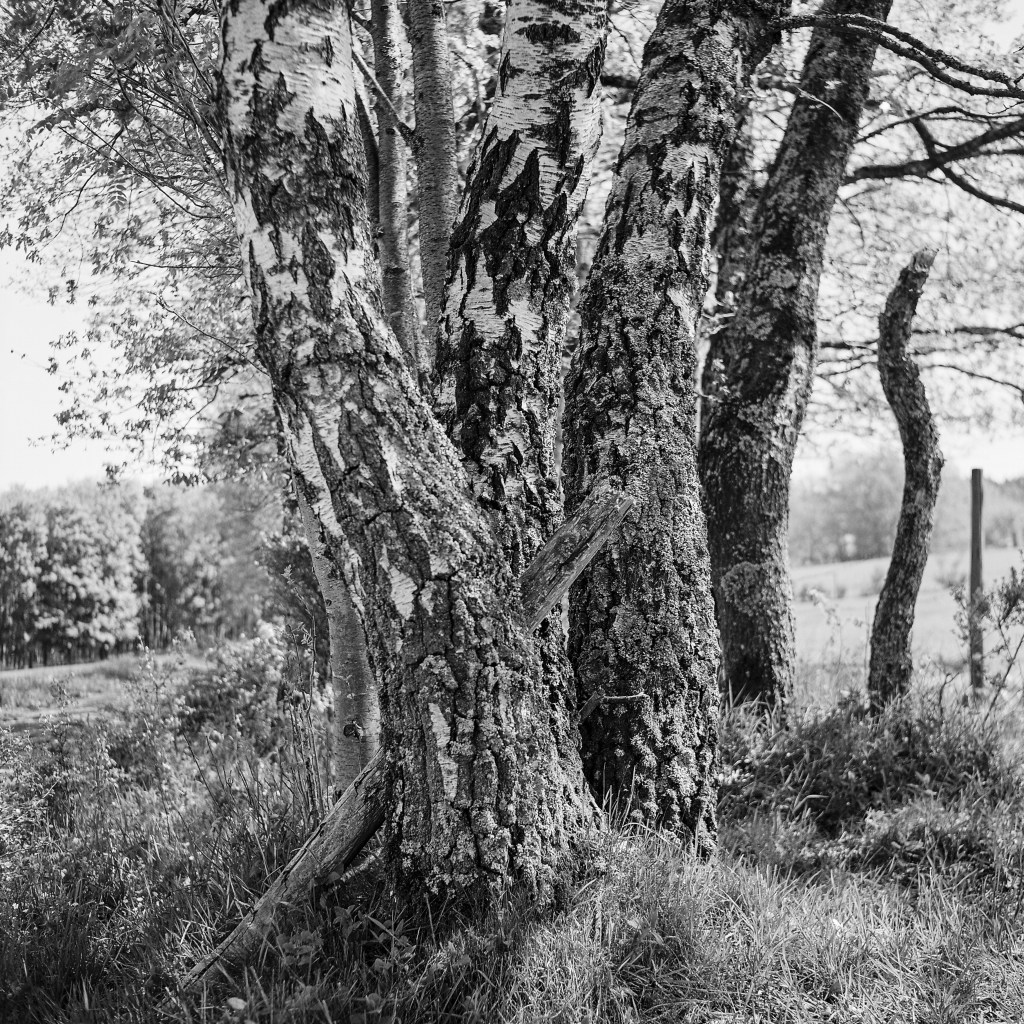
Birch trees (Zeiss Ikon Super Ikonta III, CZ Tessar, Ilford XP2 Super, 1/250 sec and f/5.6)
Color film
As for color shooting: I never noticed any unusual or ugly rendering of colors when shooting color negative films like Kodak Ektar 100, Kodak Portra 160 or Kodak Portra 400 with my folder cameras. The only point to be mentioned here is that the colors are more muted in case of old lenses, particularly in case of uncoated lenses. For me, the question is again, whether using modern emulsions like Kodak Ektar and Kodak Portra, or emulsions with a more nostalgic look like Kodak Gold 200. Considering the higher prices of Kodak Ektar and Portra film and my philosophy to prevent the pictorial look (old look or vintage look) of old lenses, I started to prefer Kodak Gold 200 for color shooting. The more pronounced grain in comparison to the newer Kodak film emulsions is no problem at all, at least in medium format photography.

Electoral Palace, Trier (Zeiss Ikon Super Ikonta III, CZ Tessar, Kodak Gold 200, 1/250 sec and f/11)
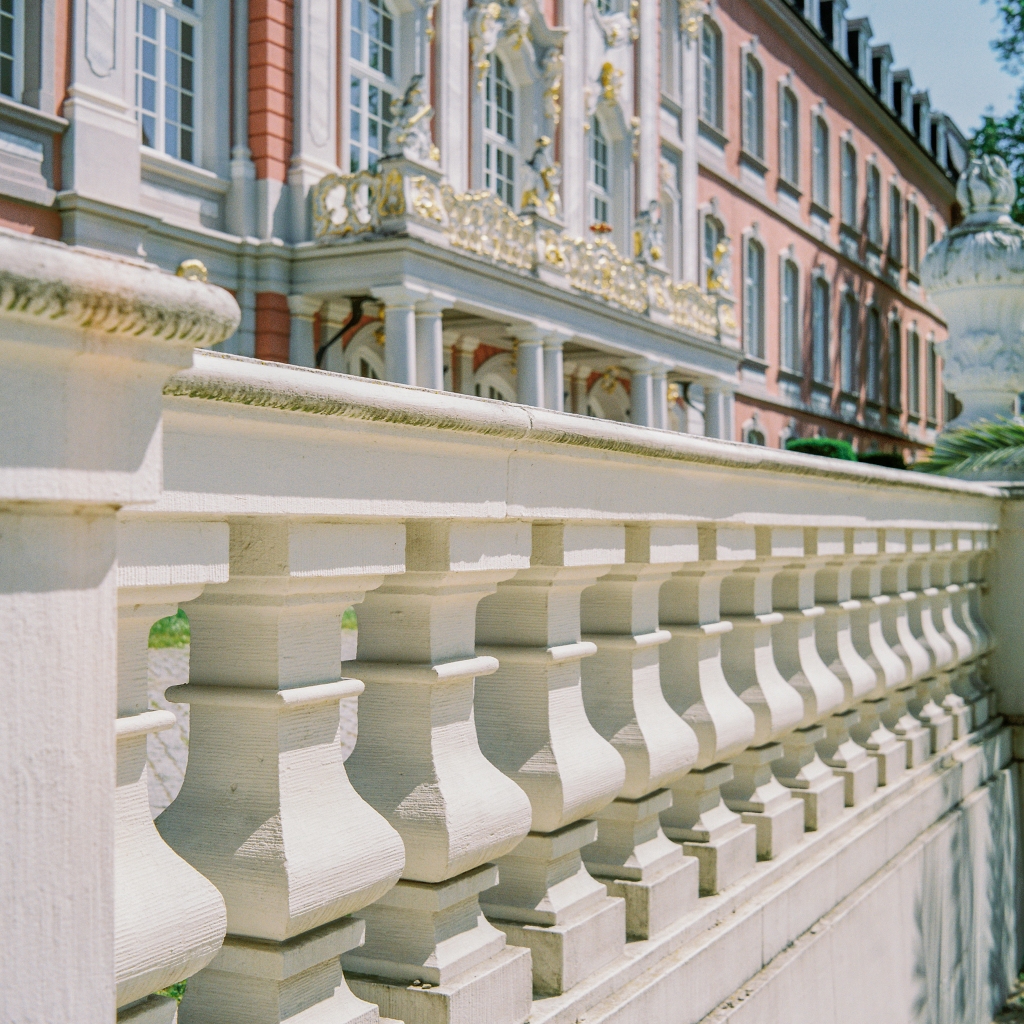
Electoral Palace, Trier (Zeiss Ikon Super Ikonta III, CZ Tessar, Kodak Gold 200, 1/250 sec and f/11)

Facade of old house, Trier (Zeiss Ikon Super Ikonta III, CZ Tessar, Kodak Gold 200, 1/250 sec and f/8)
Formerly, I used to choose color film, even when the final picture was decided to be in black & white. The main reason was the possibility of tuning the tones by using filters in post-processing. Another reason was the possibility of easily removing dust via ICE software, which is not possible in case of b & w film. Meanwhile, I prefer classic b & w film like Ilford HP5 Plus or Kodak Tri-X.
 Old Glass
You must be logged in to post a comment.